
Where does EEOB lead?
Alumni of the Department of EEOB go on to have exciting and fulfilling careers in a variety of fields. Below are just a few examples of our exceptional alumni.
Want to be among our featured alumni? We'd love to hear from you and learn what you have been up to since graduating from OSU EEOB. If you’re interested in being featured, or if would just like to update your information but not be posted, please fill out this form on Google Docs.
Academia
Jonathan Hall (Ph.D. 2011 - Dr. Tom Waite & Dr. Ian Hamilton)


Jonathan Hall is currently an Associate Professor of Biology at Eastern Michigan University. Jonathan states, "OSU EEOB helped prepare me for a career in academia through a rigorous formal education and valuable informal education. I learned a lot from the professors and also my peer graduate students. I developed a passion for teaching and learned that I was capable of high-quality scholarship...My general advice is to say yes to opportunities and focus on building and maintaining your network. I have my current job because of the contact I maintained with graduate school peers in the EEOB program. My advice for underrepresented students in this field is more specific, detailed, and nuanced. I'm open to having that conversation with such students if requested." You can read more about his research on his website.
Alex Champagne (Ph.D. 2014 - Dr. Joseph Williams)

Alex Champagne is an Associate Professor of Biology at the University of Southern Indiana, a regional public university that serves primarily undergraduate students. Alex teaches and conducts research with undergraduates. His general field of study is evolutionary and ecological physiology, with a focus on how the properties of lipid membranes regulate physiological processes such as evaporative water loss and metabolism. Alex states, "My time as a PhD student in EEOB taught me how to be an effective teacher, researcher, and mentor, and it also taught me a lot about myself and the kind of person I wanted to be going forward. The lessons I learned as a graduate student clarified my career goals and gave me a growth mindset. Along the way, I developed lifelong friendships and collaborations!" He encourages current and future EEOB graduate students to, "Set your own goals, and don't worry about what everyone else is doing or accomplishing. It's easy to feel like you're not doing enough. There are going to be highs and lows as you go through graduate school, and everyone experiences those at different times!" Find out more about Alex's teaching and research on the University of Southern Indiana's website.
Christopher Randle (Ph.D. 2004 - Dr. Andrea Wolfe)

Christopher Randle is a Professor in Biology at Sam Houston State University, an R2 university in Huntsville, TX. His day to day includes a balance of teaching and research, mostly with undergraduate students and masters students. In the last 20 years Chris has worked on a lot of different kinds of projects, mostly on the ecology and systematics of parasitic plants, but also on population genetics of turtles and fishes, forensic analysis of molecular data, phylogenetic theory, and most currently invasion biology using ecological niche models. His Ph.D. training in EEOB taught him that, "I can do hard things and that failures are valuable for growth. I was also exposed to many examples of how to be a scientist and an educator, which have helped me craft my own approach to my profession." He advises current and future EEOB graduate students to "work hard and have fun." Read more about Chris' research and teaching on the Sam Houston State University website.
Gregory Wheeler (Ph.D. 2018 - Dr. Bryan Carstens)


Rob Denton (Ph.D. 2017 - Dr. Lisle Gibbs)


Rob Denton is an Assistant Professor of Biology at Ball State University, a midsized research university, where roughly half of his time is devoted to teaching and half to research. His lab works on problems in the evolution and conservation of amphibians. Rob states, "My time in EEOB helped me gain the confidence to know I could succeed in this career. Support from the university and department allowed me to make new connections beyond campus. My cohort was a strong group of early career scientists who set a high standard." You can read more about Rob's research on his website.
Theresa Culley (Ph.D. 2000 - Dr. Allison Snow)
Drew Spacht (Ph.D. 2020 - Dr. David Denlinger)

Drew Spacht states, "At Columbus State, I work as the Biosciences Program Manager, and as the Site Coordinator and Tech for the Amgen Biotech Experience Program. As the Biosciences Program Manager, I provide technical expertise and manage the Biotech program. As the Site Coordinator and Tech for the Amgen Biotech Experience, I help train local educators on biotech labs and provide them with the equipment and technical support so they can conduct those labs with their students. In my role as Technical Advisor for the Amgen Biotech Experience, I help troubleshoot technical issues experienced by other ABE sites around the world, and help design and test new curriculum in partnership with our Technical Director, Master Lab Technicians, and Curriculum Designers. I really love STEM outreach and education, and anything I can do to further the ability of All to participate in STEM is something I want to do! My positions allow me to teach, to experiment in the lab, to get real biotech equipment into the hands of high school students throughout Central Ohio, to shape laboratory curriculum for high school students around the world, and to help shape the future of biotech education at the college level in Ohio."

During his time in EEOB, Drew feels he was fortunate to have the oppotunity to try many different techniques in the lab and travel for research. He also gained a lot of teaching experience before he graduated. Drew says, "I never thought my many, varied interests would ever be able to fit into a cohesive role, so I'm as surprised as you that I am where I am today!" He advises current and future EEOB graduate students to get out of their comfort zone...and not just in the lab. "Cook, do something artistic, read and write for fun, take a philosophy class or two! The most important thing you can do if you want to be a good scientist is to take care of yourself and to take care of your hobbies. You contain multitudes, and that's what will make you succeed and what will fulfill you," he explains.
View Drew's profile on LinkedIn.
Brady S. Hardiman (Ph.D. 2012 - Dr. Peter Curtis)

Brady Hardiman is an Associate Professor at Purdue University where he teaches courses in urban ecology and GIS. His research focuses on forest ecosystems in both natural and urban contexts. He's particularly interested in understanding how forest structure affects the capacity for forests to function as living infrastructure in cities and how we can manage them to grow more sustainable, equitable, resilient communities.
Brady says, "I had great mentors and great experiences in EEOB that continue to shape the scientist and mentor I have become. I wouldn't be where I am today without my time at OSU and in EEOB."
View Brady's profiles on Purdue's website and LinkedIn as well as a feature story in a College News article on Purdue's College of Agriculture website.
Jason Macrander (Ph.D. 2016 - Dr. Meg Daly)

Jason Macrander is an Associate Professor of Marine Biology at Florida Southern College. His time in EEOB allowed him to pursue a graduate teaching and pedagogy certificate during graduate school, which prepared him for a career in a PUI (primarily undergraduate institution). Jason advises current and future EEOB graduate students to, "Choose your own path and if there isn't one, carve it out."

Glene Mynhardt (Ph.D. 2012 - Dr. John Wenzel & Dr. Hans Klompen)

Glene Mynhardt is a Professor of Biology at Hanover College, a private, small liberal arts college in southeastern Indiana. She teaches various biology courses that bridge cell/molecular biology and ecology/evolution (the introductory biology sequence, Entomology, Comparative Anatomy & Physiology, Conservation Biology, Principles of Systematics, and Tropical Biology) and is one of only five biologists in a small department. Her research lab involves taxonomic work, insect surveys and bioblitzes, and other insect-based studies that introduce undergraduates to the nature of science. Teaching at an undergraduate institution means that all her teaching is done without teaching assistants / additional help, but also means she gets to use creative approaches to labs and field work that allow her to fully engage and connect with students.

Glene says, "I had a tough road as a graduate student between my first PhD advisor leaving the institution and dealing with significant health issues, but my time there gave me an amazing background and experiences that allow me to connect with students who may be struggling. I work as an academic advisor with many first-generation students, and my time at OSU helped me navigate my own first-generation path successfully." She advises current and future EEOB graduate students to, "Follow your instincts. If you find that you absolutely love a certain aspect of the graduate experience (as I did teaching), that may not be the path that is recommended by everyone, but it may be yours. If a project is just not coming off the ground as you had hoped, you can pivot. Use your resources, find fellow graduate students whom you can connect and share ideas with, and allow yourself time and forgiveness when things don’t seem to be going according to plan. Persistence and hard work are key to success, especially when you don’t feel like the smartest person in the room."
View Glene's profile on LinkedIn and the Hanover College website.
Ariadna Morales (Ph.D. 2018 - Dr. Bryan Carstens)
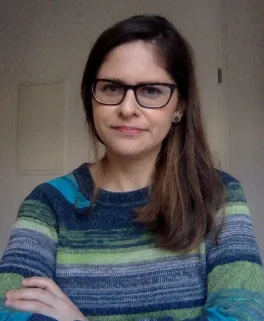
Ariadna Morales is an Assistant Professor at The City University of New York (CUNY), a public university in New York City. By integrating comparative and quantitative genomics, ecology, and computational approaches, her lab investigates the genomic basis of adaptation, immune resilience, and phenotypic diversity in mammals (with bats as her favorite model systems), with broader implications for evolution, biodiversity, disease dynamics, and human health.
Ariadna states, "My time in EEOB was an amazing experience that played an important role in shaping the scientist and academic I am today. I was surrounded by fellow graduate students and professors who felt like advanced colleagues, always interested in discussing science, exchanging ideas, and supporting our career development. Beyond my scientific training, EEOB gave me many opportunities to strengthen my leadership, teaching, writing, and communication skills, all within a friendly, collaborative, and very nice social environment."

As for advice to current and future EEOB graduate students, Ariadna suggests, "Take advantage of everything EEOB and OSU have to offer, not only scientifically but also as a community. Talk to people outside your immediate research area and beyond the department, exchange ideas, and build relationships with your fellow students and professors. Also, use graduate school as an opportunity to develop skills beyond research, including teaching, writing, communication, and leadership. These skills, and the relationships you build along the way, will continue to be valuable throughout your career."
View Ariadna's profile on her website and on BlueSky.
Sungsik Kong (Ph.D. 2023 - Dr. Laura Kubatko)

Sungsik Kong is currently a Research Scientist at the RIKENS Center for Interdisciplinary Theoretical and Mathematical Sciences (iTHEMS) in Japan where he conducts independent research projects in computational evolutionary biology, with a focus on phylogenetics and the development of statistical and computational methods for studying reticulate evolution. He will soon join Sejong University in South Korea as an Assistant Professor, where he will continue his research and contribute to teaching in evolutionary biology and related interdisciplinary fields.
Sungsik states, "EEOB was the place where I really grew into a scientist. It gave me the opportunity to focus on the research topic I love while working with a wonderful advisor and an amazing group of friends and colleagues. I'm incredibly grateful for the experiences and memories I made as a graduate student which shaped who I am today and opened the door to many exciting opportunities in my career."

He would advise current and future EEOB graduate students, "Don't be afraid to explore outside your comfort zone, and have fun with the incredible people around you. One of the best parts of my time in EEOB was building a network of friends and colleagues around the world to learn from and do research with. Those relationships made me want to pursue an academic career. I made plenty of mistakes along the way, but they taught me how to grow as both a scientist and a person."
View Sungsik's profile on GitHub.
Amy Iler (Ph.D. 2010 - Dr. Karen Goodell)


Jessie Lanterman Novotny (Ph.D. 2017 - Dr. Karen Goodell)

Jessie Lanterman Novotny is an Entomologist/Botanist for the James H. Barrow Biological Field Station at Hiram College, a small liberal arts college in NE Ohio. She researches pollinators and, more broadly, forest ecology. She supervises undergraduate students in doing independent projects for their senior capstones on a wide variety of topics from moths to mushrooms to bog insects. She also teaches Botany.
Jessie states, "My time in EEOB instilled in me that Science is a way of living and seeing the world, not simply a job, and taught me how to creatively overcome adversity."

Read more about the James H. Barrow Biological Field Station and view Jessie's Faculty and Staff Profile on the Hiram College website.
Andrew Calinger-Yoak (Ph.D. 2014 - Dr. Ian Hamilton)

Andrew Calinger-Yoak is an Associate Professor and the Director of Zoo and Conservation Science at Otterbein University where he teaches a wide range of Biology classes and trains conservation biologists. He feels his role as a former EEOB Graduate Teaching Assistant (GTA) helped him gain valuable teaching experience that translates well to his current position.
Private Industry
Alexis Wafer (PhD 2025 - Dr. Stephen Hovick)
Alexis Wafer is a Genomics Biologist II at Batelle and is responsible for Next Generation Sequencing (NGS) and library preparation for exposure health research. She feels her time in EEOB gave her necessary exposure to industry.
Kali Mattingly (Ph.D. 2021 - Dr. Steve Hovick)


Kali Mattingly is a private contractor for SpecPro Sustainment & Environmental, whose work supports the United States Environmental Protection Agency (USEPA). She remotely serves as statistician in Duluth, MN Great Lakes research office of USEPA. Kali credits her time in EEOB with her flexibility and problem solving, research and statistics/coding skills, ability to learn new things, and communicating science to fellow scientists of a variety of fields. You can view Kali's profile on LinkedIn.
Aaron Wenzel (Ph.D. 2016 - Dr. Andrea Wolfe)

Aaron Wenzel is currently a Scientific Engagement Manager on the commercial team at Seven Bridges Genomics, a cloud-based platform for multiomics bioinformatics analysis. Aaron works with the sales team to qualify deals, preform pre-sales demos, and works with current customers as they have questions/issues on our software platform. His customers are a variety of large pharma, mid-sized therapeutic, and government/academic researchers. Aaron says "My Ph.D. focused on plant evolutionary biology, which I don't use much of today, but a Ph.D. (and specifically the graduate program in EEOB) taught me flexible transferable skills beyond the science I was focused on (communication, writing, scientific engagement, etc)." Aaron advises current and future EEOB graduate students to, "Network, network, network. Regardless of your career goal, it's never too early to lean in and introduce yourself. Lean on the people you know - for example if you see that a colleague is connected on LinkedIn (or another social media platform) to someone you want to meet, reach out. The more you talk to people, the more doors could open down the road, and the better you will be at honing a concise and effective value proposition when you're looking for a job." You can view Aaron's profile on LinkedIn.

Mary Sagatelova (MSc. 2021 - Dr. Andrea Wolfe)

Mary Sagatelova is a Senior Advisor for Energy and Foreign Policy at Third Way and works at the intersection of clean energy, climate, foreign policy, and domestic politics. She explores the geopolitical implications of energy systems and the transition to cleaner technologies alongside political analysis and public opinion research related to Democratic campaigns and policy priorities. Her work focuses on analyzing public opinion trends, voter behavior, and messaging strategies to understand how energy and foreign policy issues resonate with different constituencies. Through this, she contributes to research and strategy that bridges policy and politics, helping to inform more effective, data-driven approaches to advancing Democratic priorities on energy and foreign policy.
Mary says her degree from EEOB, along with her research focus on conservation, provided a strong foundation in scientific thinking, data analysis, and systems-level understanding that continues to inform her work today. She elaborates, "Studying complex biological systems also gave me an entry point into climate science and a deeper understanding of the environmental challenges connected to energy use. Alongside my time at EEOB, I pursued a Master of Public Administration from the John Glenn College, and completed both degrees concurrently, giving me valuable experience at the intersection of science and policy. This combination strengthened my ability to translate technical concepts into accessible insights and communicate effectively with a range of audiences, which has been central to my current work bridging energy, climate, and policy."
Mary advises current and future EEOB graduate students to develop the ability "to communicate your work clearly and concisely to a broad audience! Science and academia emphasize depth and precision, which are critical, but the ability to translate complex ideas into accessible, compelling language is equally important! I would encourage all students to actively practice writing for non-specialist audiences, whether through blog posts, Substacks, or other informal platforms. Learning how to be both accurate and brief will make your work more impactful and open up a wider range of opportunities beyond academia!"
You can view Mary's profile on LinkedIn and the Third Way website.
Christian King (MSc. 2018 - Dr. Steve Hovick)
Christian King is an Environmental Scientist with Burns & McDonnell in Environmental studies and permitting for renewable development. When asked how his time in EEOB helped him, Christian states, "My technical skills were way ahead of the game compared to those with two years experience in industry. This included both field skills and technical writing skills. Christian advises current and future EEOB graduate students to "Have a career path clearly identified while getting your graduate degree so you can tailor your coursework and research to develop required skills. [It] Will make the transition much easier."
Drew Spacht (Ph.D. 2020 - Dr. David Denlinger)
Drew Spacht states, "At Columbus State, I work as the Biosciences Program Manager, and as the Site Coordinator and Tech for the Amgen Biotech Experience Program. As the Biosciences Program Manager, I provide technical expertise and manage the Biotech program. As the Site Coordinator and Tech for the Amgen Biotech Experience, I help train local educators on biotech labs and provide them with the equipment and technical support so they can conduct those labs with their students. In my role as Technical Advisor for the Amgen Biotech Experience, I help troubleshoot technical issues experienced by other ABE sites around the world, and help design and test new curriculum in partnership with our Technical Director, Master Lab Technicians, and Curriculum Designers. I really love STEM outreach and education, and anything I can do to further the ability of All to participate in STEM is something I want to do! My positions allow me to teach, to experiment in the lab, to get real biotech equipment into the hands of high school students throughout Central Ohio, to shape laboratory curriculum for high school students around the world, and to help shape the future of biotech education at the college level in Ohio."
During his time in EEOB, Drew feels he was fortunate to have the oppotunity to try many different techniques in the lab and travel for research. He also gained a lot of teaching experience before he graduated. Drew says, "I never thought my many, varied interests would ever be able to fit into a cohesive role, so I'm as surprised as you that I am where I am today!" He advises current and future EEOB graduate students to get out of their comfort zone...and not just in the lab. "Cook, do something artistic, read and write for fun, take a philosophy class or two! The most important thing you can do if you want to be a good scientist is to take care of yourself and to take care of your hobbies. You contain multitudes, and that's what will make you succeed and what will fulfill you," he explains.
View Drew's profile on LinkedIn.
Julianne Busa (PhD 2009 - Dr. Tom Waite & Dr. Libby Marschall)

Julianne Busa is Owner and Senior Restoration Ecologist of Truly Ecological, an assessment, design, and permitting firm dedicated to process-based ecological restoration. Truly Ecological has specialties and focus areas in cranberry bog restoration (including planning for marsh migration in near-coast bog systems) and inland streams and wetlands (with a growing practice in golf course rewilding). They currently work on projects throughout Massachusetts. Julianne has personally served as a technical lead and project manager on a variety of projects including: cranberry bog restoration from design through implementation, dam removal and river restoration; culvert and stream improvements to improve aquatic passage; and nature-based slope stabilization and green infrastructure design. She says, "Before founding Truly Ecological, I led the ecological restoration practice team at Fuss & O’Neill, a ~400+ person New England-based civil engineering firm. I also serve as co-lead of the Massachusetts Ecosystem Climate Adaptation Network (MassECAN) Slow the Flow Working Group and am the Chair of the City of Easthampton Conservation Commission. In addition to my EEOB PhD, I am certified as a Professional Wetland Scientist, Certified Senior Ecologist, and Certified Ecological Restoration Practitioner."
Julianne feels her PhD work helped develop the ability to think independently, research a problem, integrate and synthesize knowledge, and write for a wide variety of technical and non-technical audiences. Those skills are invaluable in her current work. And she occasionally gets to put her statistics and modelling skills to work.

Julianne advises current and future EEOB graduate students to "Take every opportunity you can get to develop your own independent thinking skills and pursue your own work. Whether you stay in academia or move into the private sector, the ability to be accountable for your own work product is a skill in high demand, and one that even many graduate students on the job market do not have."
View Julianne's profile on the Living Observatory website and on LinkedIn.
Cheyenne Dang (MSc 2023 - Dr. Karen Goodell)

Cheyenne Dang is a Senior Environmental Lead for siting and due diligence of new solar, wind, and nuclear projects for American Electric Power (AEP). Utilities have a lot of sites they plan to develop to keep up with rising electricity demand, and we in Environmental Services ensure these projects are minimizing, mitigating, and permitting impacts to important resources such as wetlands/streams, federal and state-listed Threatened & Engandered species, and cultural resources.
Cheyenne states she was able to first get her foot in the door at AEP at their chemical laboratory by leveraging her lab/research skills gained in EEOB. From there, she used her learned networking skills to work her way into their headquarters--into the career path she has now.

She advises future and current EEOB graduate students to look everywhere when looking for a job. She elaborates, "Places that you wouldn't even think would have a lab or environmental services department. Utilities have to abide by environmental laws and they need people to help pave the way for them, especially with a huge nuclear boom incoming. Look into Environmental Health & Safety certs that you can get while you have the time to do them."
View Cheyenne's profile on LinkedIn.
Coleen Thompson (BSc. 2017 and MSc. 2019 - Dr. Bryan Carstens)

Coleen Thompson is a Research Assistant IV at Cincinnati Children’s Hospital and Medical Center in the Department of Human Genetics under Dr.Yuriy Baglaenko. She is the lead researcher on a project aimed to develop new multi-omic single cell sequencing technology to investigate genetic editing of variants indicated in autoimmune diseases. She also collaborates with PIs from universities such as John Hopkins to understand variants in CFTR (Cystic Fibrosis), and TNFRSF1 (TRAPS). Coleen states, "EEOB course and lab work prepared me to be a full time scientist in a genetics lab. The bench techniques, bio-informatics, and writing skills learned in both my undergrad in EEOB and graduate school helped me become a productive researcher."
She advises current and future EEOB graduate students to "Take advantage of the opportunity to learn the different techniques and projects going on in the department. Be curious and don’t be afraid to ask questions!"
View Coleen's profile on LinkedIn and find out more about the Baglaenko Lab at Cincinnati's Children's Hospital and Medical Center.

Public Service
Jonathan Horn (MSc 2010 - Dr. David Culver)

Jonathan Horn is currently the H2Ohio Rivers Program Manager for the Ohio Department of Natural Resources (ODNR). He believes his time in EEOB helped him with network building, skills development, and a variety of experience solving real academic and scientific problems. Jonathan advises current and future EEOB grad students to, "Put yourself and your work in front of as many folks in your intended career path as possible. Networking and relationship development is as important as your academic work. Take time to do internships, volunteer, and do other social and network building tasks that may not advance your dissertation or thesis."
Jeramy Pinkerton (MSc. 2016 - Dr. Libby Marschall)
Jeramy Pinkerton is the Lake Superior and St. Louis River Team Supervisor for the Minnesota Department of Natural Resources (DNR). He leads a team that completes large scale habitat restoration projects that typically support the delisting of the St. Louis River Area of Concern and/or the Lake Superior Lake Action Management Plan. Jeramy's time in EEOB helped him develop the skills (technical and social) he learned as a TA and researcher and helped to get his foot in the door with the Minnesota DNR. He suggests current and future EEOB graduate students, "Stick with and do things that challenge you/move you outside of your comfort zone."
James Feller (Ph.D. 2022 - Dr. Roman Lanno)


Katherine Saju Parakal (PhD 2024 - Dr. Roman Lanno)
Katherine Saju Parakal is a Risk assessor evaluating human health risk assessment with the Ohio EPA. She states, "I had a wonderful time [in EEOB] and my advisor and the program coordinator, Corey, were especially supportive. Corey Ash played a truly pivotal role in my journey and success. She was always incredibly responsive and supportive, going above and beyond to help me secure funding—even when opportunities were limited, she personally reached out to numerous places and resources to help me find options. When my defense was postponed, she provided the moral support and encouragement I needed during a difficult time. She also shared valuable resources that played an important role in helping me secure a job and ultimately reach where I am today. I am deeply grateful for her guidance, dedication, and unwavering support throughout this journey.
Katherine advises current and future EEOB graduate students to, "Start networking from day one—build meaningful relationships with professors, peers, alumni, and professionals, because the connections you make throughout your academic journey can play a pivotal role in your future career."
Heather Glon (Ph.D. 2021 - Dr. Marymegan Daly)

Heather Glon is the Director of Program Analytics at the Maine Department of Marine Resources. She's a member of the leadership team, providing advice and support for all technology-related issues, policies, and needs. Heather serves as the IT liaison for 200+ staff members, providing guidance for analytics and technology solutions. She also manages their scientific database, licensing & enforcement system, and other agency-specific tools in collaboration with developers and scientific staff. Prior to this, Heather spent 3.5 years as the Senior Lobster Research Biologist at ME DMR, where she led an early life history monitoring survey and collaborative research projects supporting the lobster stock assessment.
Heather states, "Being in the Daly Lab at EEOB gave me so much opportunity to learn, grow, and gain experience that has continued to shape my career. I’ve been continually impressed by how much my background in sea anemone biogeography has translated into my work in fisheries research and program analytics: from big data management, coding, scuba diving around the world, scientific writing and grant development to data visualization and public policy. Most importantly, the projects I worked on while in EEOB taught me how to be an effective collaborator and leader. Those broader skills have been just as valuable as the technical ones." She advises current and future EEOB graduate students that what they study during grad school doesn’t necessarily lock you into an organism or field for life. Heather elaborates, "Enjoy every moment of your research, and focus also on gaining versatile skills that can be applied broadly. Equip yourself to follow the opportunities and your future interests - you never know where you’ll want to end up!"
View Heather's profile on LinkedIn.

Non-profit
Lara Metrione (Ph.D. 2010 - Dr. John Harder)

Lara Metrione is Operations Manager for the South-East Zoo Alliance for Reproduction & Conservation. She coordinates scientific and business operations through research project management, communicating with zoo and aquarium members about specific reproduction and wellbeing cases, and organizational management, as well as participating in research collaborations. Lara states, "My graduate research was directly related to the same type of studies in which I and the company I work for are engaged, thus my time in EEOB provided the knowledge and training that are foundational to my career." She advises current and future EEOB graduate students to pick a research area that they are passionate about so that, when the inevitable challenges and obstacles occur, they are motivated to keep exploring.
Sarah Cusser (MSc. 2013 - Dr. Karen Goodell)

Sarah Cusser is a Terrestrial Invertebrate Conservation Ecologist at the Santa Barbara Botanic Garden where she leads insect-plant interaction studies to advance biodiversity conservation, habitat restoration, and urban habitat creation. Sarah states EEOB prepared her to start her PhD and execute field work. She advises current and future EEOB graduate students to adopt the following: "If something's going wrong, deal with it as soon as possible (don't put it off)."
Find out more about Sarah's work on the Santa Barbara Botanic Garden website.
Amy Iler (Ph.D. 2010 - Dr. Karen Goodell)
Cody Cardenas (MSc. 2020 - Dr. Rachelle Adams)

Cody Cardenas currently is an external research associate in the Toussaint lab at The Natural History Museum of Geneva. In September he will be starting a post-doc at LUOMUS, Helsinki (the natural history Museum of Helsinki) where he will be working with Kyung Min Lee to investigate the population genetics of the Red Listed Parnassius apollo butterfly through museomics. In parallel, collaborators will use isotope analysis to understand the broader context of the ongoing population decline of this species.
Cody states, "EEOB holds a special place in my heart. The people and support I received help shape how I approach research. My undergraduate and masters advisor, Dr. Rachelle Adams, helped me learn how to direct my stubborn persistence into tackling interesting research questions. The people I met during my time at EEOB led to long term friendships and a broad network. But more broadly, the mentorship and training I received from faculty, staff, and peers helped me establish a foundational understanding of evolution so I can ask questions about how species have changed through time and how they are adapting to our changing world." He advises current and future EEOB graduate students, "Don't do things alone, ask for help when you need it, and don't wait too long to ask. There are likely others that already have a solution, but they are probably willing to help you figure it out. After all, science is better when done in a collaborative and supportive environment!"

View Cody's profile on ResearchGate and BlueSky.