Sean Fitzsimmons, EEOB Class of 2024
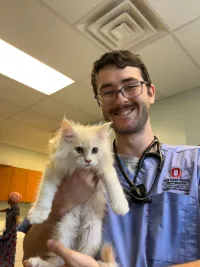
For many Buckeyes, the path from an undergraduate degree in Zoology to a career in medicine is a natural progression. We recently caught up with one of our recent graduates, Sean Fitzsimmons, who is doing exactly that, staying right here at Ohio State to pursue his DVM. Now in his second year of veterinary school, Sean shared how his time in the EEOB department provided the foundational building blocks for his professional journey.
While many pre-vet students gravitate toward Animal Sciences, Sean chose Zoology for its depth in evolutionary theory and taxonomy. "I chose the Zoology route because I thought that taking classes like comparative anatomy, histology, and microbiology would all help me out later," he noted.
This decision proved fruitful. The flexibility of the OSU Zoology curriculum allowed Sean to explore diverse interests. "There were many classes I didn’t take that I would have if I had another year," he recalled. "Most had relevance to my goal, and the ones that didn’t, I found interesting to begin with."
The transition from undergraduate to professional school is often shaped by key faculty. For Sean, Dr. Erin Lindstedt played a pivotal role. What started as a simple meeting to decide between Comparative Physiology and Comparative Anatomy turned into a multi-semester collaboration.
"Working with Dr. Lindstedt certainly had the greatest impact on my experience," Sean said. After taking Comparative Physiology, a course he describes as "imperative" to his current vet school knowledge, he went on to serve as a teaching assistant for Dr. Lindstedt’s Neurobiology of Behavior and Comparative Physiology courses.
His academic preparation also led to some surprising "aha" moments. "The best relationship I found was using Physics concepts in Comparative Physiology to understand how cardiovascular and respiratory systems work. It was something I hadn’t thought about but was extremely helpful for my understanding."
The skills Sean gained in EEOB aren't just theoretical. These skills are being applied in the clinic every day. From maintaining aseptic techniques learned in microbiology to analyzing complex scientific literature, his transition has been seamless.
Currently, Sean is involved in cutting-edge radiology research, analyzing CT scans of gorilla aortas to develop screening methods for early heart disease in zoo populations. This past summer, he even completed an externship where he moved from theory to practice, seeing appointments and performing surgeries!
Beyond the technical skills, the Zoology program shifted Sean's perspective on the environment. "Ecology changed my view on nature," he explained. "I learned how concepts like symbiotic relationships and the energy pyramid factor into pollution and climate change. As a future veterinarian, I see the importance of these concepts in educating clients about how we can preserve our environment."
And, of course, a Zoology degree wouldn't be complete without a memorable animal encounter. During his senior year, Sean narrowly avoided stepping on a tiny baby squirrel on campus. "I picked him up to move him to the grass, and he jumped off my hands and clung to my shirt!" After a quick rescue mission to hide him from nearby hawks, it was a fitting "fieldwork" finale to a successful undergraduate career.
Dr. Amy Iler, PhD 2010, Advisor Dr. Karen Goodell
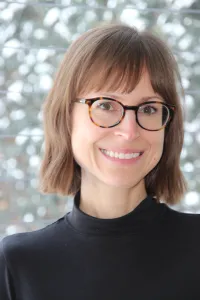
Dr. Amy Iler is Conservation Scientist at the Chicago Botanic Garden and an Associate Professor at Northwestern University. She started this position in 2016 after about four years as a postdoctoral research associate at the University of Maryland and two years as a Marie Curie-Cofund Research Fellow in Aarhus Denmark. Dr. Iler is a leading voice in the field of plant population biology through her research investigating how anthropogenic factors influence plant populations. Her work has made major contributions to our understanding of the effects of climate change on phenology and population dynamics of alpine plants. Dr. Iler likens her current position to a faculty position at an R1 academic institution with “a bit more outreach and service”. She teaches undergraduate science courses and has mentored graduate students through CBG’s partnership with Northwestern University. Dr. Iler credits her professional success in part to the excellent mentoring she received in the EEOB department and the “amazing community of graduate students in EEOB”. Her advice to the next generation of graduate students is “Don't feel like you have to work during evenings and weekends to succeed. Work-life balance is so important!” Great advice, Dr. Iler!
Visit Dr. Isler's professional website on Weebly.