Isabel Pen

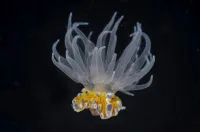
My name is Isabel Pen and I'm a 5th year PhD student in Dr. Meg Daly's lab. To study the evolution of sea anemones, my research has taken me all around the world! In the past five years, I've come to learn how diverse, fascinating, and sadly understudied these animals are. My work integrates field work, morphological investigation, and genomics to study the systematics, biodiversity, and biogeography of these charming marine invertebrates. In addition to clarifying species identities and cataloging hidden biodiversity, I also use the genomes of sea anemones to investigate the evolution of the mitochondria for this group. Going to grad school here at OSU has given me opportunities to analyze my data on the high-performance computing cluster, travel the world for my work, and make valuable contributions to my field. My ultimate goal is to help build a stronger taxonomic framework for sea anemones that can support future research into the ecology and evolution of these amazing animals!
Lizzy Sakulich
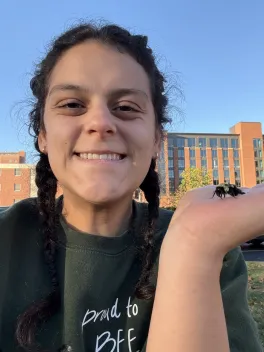
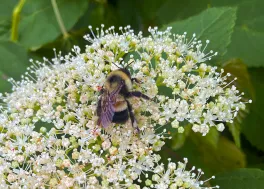
Broadly, my interests are in pollinator conservation, though my research has primarily been with bees. I have long been interested in bees, from watching them in my garden as a kid to researching them for my undergrad thesis, but having the opportunity to continue research in graduate school has only fueled that passion even more! As part of my master’s work in Dr. Karen Goodell's lab, I studied bumble bee communities in the Central Appalachians, with a focus on the endangered Rusty-patched bumble bee, Bombus affinis (pictured on the flower below - not the species of bumble bee in my hand, which is a common Eastern bumble bee). For the other half of my thesis, I analyzed data collected as part of the Ohio Bee Survey, an ongoing effort to document Ohio's bee species. With this data, I investigated how species traits influence the detection of different bee species in pan traps. I recently presented that chapter at the Entomological Society of America 2025 Annual Meeting, where I placed first in my section of the grad student competitions. Just one week later, I successfully defended my full master’s thesis! I am very thankful for the opportunities I have had in EEOB, and I love the opportunities research offers to continue learning. Now that I am graduating, I plan to apply this knowledge to a career in outreach and science communication. The support that I received from faculty, staff, and other students was instrumental in making me the researcher that I am today. During my time as a graduate student researcher in EEOB, I have made lasting connections that I will cherish for life!
Meredith Bennett
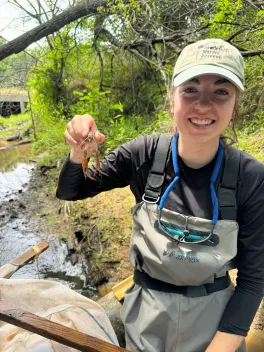

My research is focused on intermittent streams (streams that go periodically dry) in the south-central United States, specifically southeastern Oklahoma and eastern Kansas. I characterize patterns of stream drying using in-stream sensors and game cameras. I also conduct surveys of fish and crayfish to link biotic communities to drying patterns. In addition to these overarching goals, I am interested in the movement patterns and dietary shifts of species in intermittent streams. One of my favorite things about this work is observing how, despite frequent disturbance, diverse organisms can survive in these small, unpredictable environments. There is a true sense of encouragement from everyone in the EEOB department, and I've appreciated being challenged and supported during my time in Dr. Lindsey Bruckerhoff's lab at Ohio State.