Faculty Spotlight: Dr. Jeanne Serb
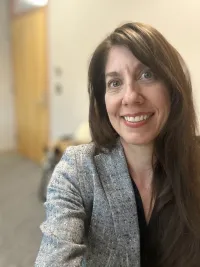
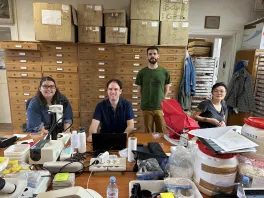
With great pleasure and anticipation, we welcomed our new EEOB Chair, Dr. Jeanne Serb, in January 2026. Dr. Serb comes to Ohio State after two decades on the faculty at Iowa State University, where most recently she served as Professor and Director of the Office of Biotechnology. In that role, she oversaw nine core instrumentation facilities and led an externally funded Research Experiences for Teachers program that placed K–12 educators in research labs each summer. This model outreach program brought science to classrooms across the state.
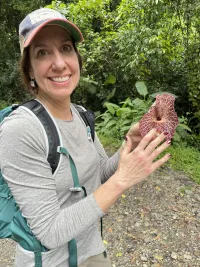
Dr. Serb’s research program explores one of the most fascinating basic frontiers in biology, how organisms sense light, and how these mechanisms drive the evolution of biological diversity. Her lab uses a study system of marine bivalves, including scallops, oysters and mussels (yes, the tasty ones!) that have evolved eyes at least five times separately. Using genomic, developmental, and biochemical approaches, her team investigates questions such as:
- How does genomic changes alter the organism’s phenotype?
- What factors and forces contribution to the evolution and diversification of eyes?
- How do changes in the protein alter light-sensing function of the eye?
When asked what drew her to EEOB, Dr. Serb highlighted the “collegiality, diversity of research programs, and the amazing research support in the Museum of Biological Diversity and Aquatic Ecology Lab.” We are happy that these strengths resonated with her, and even more excited for the leadership, energy, and vision she brings to the department.
Faculty Spotlight: Dr. Elizabeth Santos
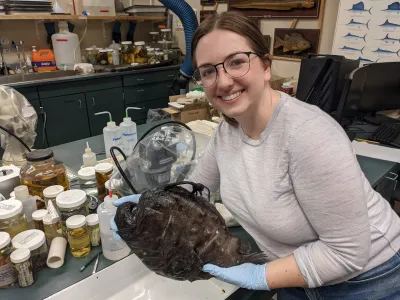
The EEOB department is thrilled to welcome Dr. Elizabeth Santos, who joins us after completing a postdoctoral position at UC Irvine. Before that, she held an NSF Postdoctoral Fellowship through placements at both the University of Washington and the University of Oklahoma. These experiences helped shape her broad, comparative approach to studying biodiversity.
Dr. Santos explores some of the biggest questions in macroevolution: How did the incredible biodiversity we see today come to be, and why does it vary so dramatically across habitats? She focuses on rayfinned fishes, a remarkably diverse group with more than 30,000 species distributed across nearly every aquatic environment on Earth. Recently, her work has taken her into the deep sea, where fishes such as anglerfishes show unusually high bodyshape diversity and rapid evolutionary rates. Dr. Santos aims to study these patterns using phylogenetic and genomic tools. She is also passionate about freshwater systems, viewing river fish communities as natural case studies for understanding evolution and ecology in real time.
What drew Dr. Santos to EEOB? “The intellectual diversity here is incredible,” she says. She sees potential collaborators across the Museum of Biological Diversity, the Aquatic Ecology Lab, and Aronoff. She’s especially excited about the Fish Division’s extensive collections, which offer unparalleled resources for her research. Just as important, she’s inspired by the department’s strong, supportive graduate student culture, including the funded Master’s program.
Faculty Spotlight: Dr. Nathan Whelan
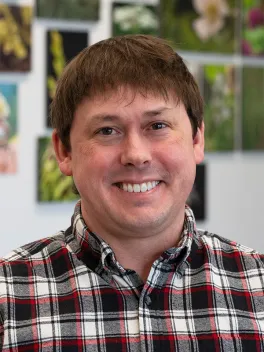
We are delighted to welcome Dr. Nathan Whelan to the EEOB department! Dr. Whelan joins us from the U.S. Fish and Wildlife Service, where he served as the Southeast Regional Geneticist in Auburn, Alabama. Dr. Whelan held a dual appointment as a faculty member in Auburn University’s School of Fisheries, Aquaculture, and Aquatic Sciences. In this capacity, he led the USFWS genetics program for the region and directed a federally funded research lab focused on applying genomic tools to improve conservation outcomes.
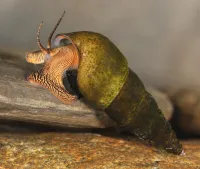
Dr. Whelan’s research centers on understanding how organisms are related, how biodiversity originates, and how environmental changes shape genetic diversity and population dynamics. His lab primarily studies freshwater mollusks, an ecologically important and highly imperiled group, but his work extends across a wide range of aquatic taxa. Broadly, his team operates at the intersection of systematics and conservation genetics, bridging fundamental evolutionary questions with applied conservation needs.
As the new Director of the Museum of Biological Diversity, Dr. Whelan is also deeply committed to strengthening and supporting collections-based research at Ohio State. He is particularly excited about increasing public engagement with the MBD and advancing the future of its world-class research collections.
What excites him most about joining EEOB? “The opportunity to lead one of the largest university-based natural history collections in the world,” he says, he is also eager to work with our outstanding students and collaborate on cutting-edge systematics and conservation genetics research.